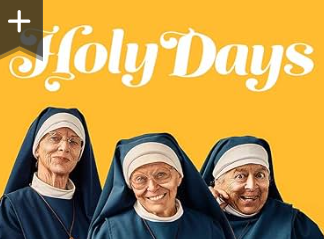
There is a moment in Holy Days — roughly two-thirds of the way through — where the film stops being about what you thought it was about. The conversation is quiet. Almost nothing happens on screen. But the emotional weight of what is said lands like something physical. I put my pen down and did not pick it up again for several minutes.
That scene is the reason this Holy Days parents guide exists. It reframes everything before it. And for a certain kind of child — one who is already carrying grief, or confusion about faith, or complicated family dynamics — it will not leave them quickly.
Quick Answer: Is Holy Days Safe for Kids?
With Caution — Holy Days is a quietly intense drama that deals with faith, family fracture, and moral grief in ways that are more emotionally challenging than any surface-level content warning captures. Best suited to viewers 14 and older, ideally watched with a parent ready to talk afterward.
Holy Days Age Rating — Quick-Scan Safety Card
Not Yet Rated (NR) — Australian theatrical release May 2026; classification pending at time of writing
14+ (my assessment — younger teens may find the emotional content distressing without context)
Low-moderate — no action sequences; some scenes carry implied threat and emotional confrontation that can feel more distressing than physical violence
Mild to moderate — occasional strong language used in moments of emotional breakdown; nothing gratuitous
Faith crisis, family estrangement, grief, moral ambiguity — these are the real content concerns here, not surface-level classification triggers
The emotional intensity is far higher than the trailer suggests. Several scenes deal directly with loss of faith and family breakdown in ways that linger well past the credits
Grief, religious doubt, parental conflict, implied emotional abuse within family structures
| Category | Detail |
|---|---|
| Official Rating | Not Yet Rated (NR) — Australian theatrical release May 2026; classification pending at time of writing |
| Expert Recommended Age | 14+ (my assessment — younger teens may find the emotional content distressing without context) |
| Violence | Low-moderate — no action sequences; some scenes carry implied threat and emotional confrontation that can feel more distressing than physical violence |
| Language | Mild to moderate — occasional strong language used in moments of emotional breakdown; nothing gratuitous |
| Themes | Faith crisis, family estrangement, grief, moral ambiguity — these are the real content concerns here, not surface-level classification triggers |
| What Will Surprise Parents Most | The emotional intensity is far higher than the trailer suggests. Several scenes deal with loss of faith and family breakdown in ways that linger well past the credits |
| Trigger Warnings | Grief, religious doubt, parental conflict, implied emotional abuse within family structures |
What Is Holy Days About? (No Spoilers)
Holy Days is a drama centred on a family gathering — the kind that is supposed to be meaningful and ends up being the opposite. Religious tradition and personal doubt collide across generations. Old wounds get opened in living rooms and across dinner tables.
Emotionally, it feels like watching a pressure cooker. The film is not loud. That is almost the problem. The tension builds through silence and half-spoken truths, and by the third act the air has gone out of the room in a way that is genuinely difficult to sit with.
If you have ever watched a film and felt it was uncomfortably close to conversations from your own childhood, Holy Days may feel very familiar. That is both its strength and the reason I am writing this Holy Days parental guidance piece.
Why Is Holy Days Not Yet Rated — And What That Actually Means
The Australian theatrical release is scheduled for May 28, 2026, and at the time of publishing this guide, a formal classification from the Australian Classification Board has not been confirmed publicly. That matters. “Not Yet Rated” is not the same as “safe.”
Based on the thematic content — grief, faith crisis, family conflict, emotionally confrontational dialogue — I would expect this to land somewhere between MA15+ and M in the Australian system. Possibly M with content advice for “mature themes.”
My honest view is that any classification in that range would be roughly accurate for the surface content but would significantly underestimate the emotional weight. An M rating can make a film sound like a manageable watch for a 12-year-old. This one is not. The content that will affect children most is not the kind that classifications are designed to capture.
Check the Australian Classification Board website closer to the release date for the confirmed rating. Until then, treat this as a 14+ film based on thematic content alone, regardless of what the official classification turns out to be.
Content Breakdown
Emotional Intensity and Family Conflict
This is where Holy Days earns its place on parents’ radar. The confrontations between family members are not shouting matches. They are quieter and colder than that — and somehow harder to watch. There is a scene involving an adult child and a parent where years of unspoken resentment surface in about four lines of dialogue.
I have spent fifteen years studying how media affects children emotionally. I still found that scene uncomfortable. Not because it was graphic — because it was real. Children who have experienced family estrangement or tension at home will recognise the dynamic immediately.
If your child has experienced parental conflict or family breakdown, this film may surface feelings they have not had language for yet. That can be valuable — but it should happen with you present, not on a streaming service at midnight alone.
Faith, Doubt, and Religious Themes
Holy Days does not treat religion as background texture. It is central. Characters argue about belief, about whether ritual still means anything, about the gap between what faith promises and what life delivers. None of this is presented with easy answers.
For families with strong religious convictions, some of this dialogue may feel provocative. That is not necessarily a flaw in the film — but it is something to know going in. Teenagers in the middle of their own faith questioning may find the film lands differently than you expect.
If faith is an active part of your family life, watching this together and debriefing afterward is genuinely worthwhile. The film raises real questions — it just does not hold your hand through them.
Grief and Loss
Grief runs underneath almost every scene in the film. Some of it is the grief of losing a person. Some is the grief of losing a version of your family you thought you knew. There is no cathartic release moment — the film sits in the feeling rather than resolving it.
My middle child, who is thirteen, has been through a significant loss in the past two years. I would not show her this film yet. Not because it would break her — she is resilient — but because the way grief is handled here requires a certain emotional maturity to process productively rather than just absorb.
If your child is currently in active grief — recent loss, family illness, bereavement — this is probably not the right film for this moment. Revisit it in a year or two.
Language and Tone
The language is not what will concern most parents. There are moments of stronger language during emotional peaks, but nothing sustained or gratuitous. The tone — cold, heavy, unresolved — is a far greater consideration than any specific word used.
Age-by-Age Viewing Guide for Holy Days
Not Appropriate
There is nothing here for very young children. The pacing, tone, and subject matter bear no relationship to what under-fives need from a screen experience. This is simply not a film for this age group in any context.
Not Appropriate
Children in this range would likely find the film confusing and the emotional tension distressing in ways they cannot process. Family conflict on screen affects children in this developmental window more than many parents realise. Skip it entirely at this age.
Not Appropriate
This is the age group I would be most cautious about, honestly. Eleven to thirteen-year-olds are right in the middle of forming their own sense of family, faith, and identity. This film presses on all three without resolution. It is not that they would not understand it — some would understand it too well. Wait for 14.
With Caution
This is the age where Holy Days starts to become genuinely valuable viewing — with the right support around it. Teenagers at 14 to 16 are asking real questions about family, belief, and who they are. This film engages those questions seriously. Watch it together. Talk afterward. Do not leave them sitting with it alone.
Appropriate
At seventeen and above, this is exactly the kind of film that rewards a thoughtful audience. The emotional complexity, the unresolved questions, the way it refuses easy comfort — these are features, not flaws, for a viewer who is ready for them. Strong recommendation for this age group.
Positive Messages and What Families Can Take From It
Holy Days is not a feel-good film. I want to be clear about that so you are not surprised. It does not wrap its themes in resolution or send you home with tidy answers. But that does not mean it is without value — the opposite, actually.
The film takes the idea of family seriously enough to show how it can fail. It takes faith seriously enough to show doubt. There is something honest about a drama that does not pretend these things are simple. For older teenagers especially, that honesty is rare and worth something.
The richest conversations this film generates are around what we owe each other inside families, whether traditions carry meaning when belief changes, and how grief changes the way people treat the people they love. Those are not small topics. They are the kind that stay useful for years.
Five Family Discussion Questions
- When the family gathers in the film, each person seems to want something different from the occasion. What do you think each of them actually needed — and why could they not ask for it directly?
- The film shows characters who still follow religious traditions even after their belief has changed. Does going through the motions of something you no longer fully believe in feel dishonest — or is there another way to look at it?
- There is a confrontation in the film where something true is said in a way that causes real harm. Is saying something true always the right thing to do? Does the way you say it change whether it is kind?
- How does grief change the way people in this film talk to each other? Have you ever noticed that happening in real life — where sadness comes out as anger or silence instead?
- By the end of the film, nothing is fully resolved. Does that feel unsatisfying — or does it feel more honest than a tidy ending would have been?
Frequently Asked Questions
No. The emotional weight of this film — family conflict, grief, faith crisis — is genuinely difficult material for under-thirteens. Even without strong violence or sexual content, the themes are heavy in ways that require a level of emotional processing most children in that age range have not yet developed.
Not in a jump-scare or horror sense. The fear in this film is quieter — it comes from family tension, confrontational dialogue, and the feeling that something irreparable is happening between people who love each other. For sensitive children under 12, that kind of tension can be more upsetting than anything visually frightening.
Based on the tone and genre of this film, a post-credits scene is unlikely. Dramatic films of this kind rarely use that device. That said, I would suggest staying through the credits regardless — the final frames of the film itself are worth sitting with before you stand up.
Nothing in the trailers or available production material suggests strobe lighting or rapid flashing sequences. This is a drama with a naturalistic visual style. If your child has photosensitive epilepsy, the standard caution applies — but this genre is very low risk compared to action or horror films.
Holy Days is scheduled for Australian theatrical release on May 28, 2026. Streaming availability has not been confirmed at the time of writing. When it does arrive on a platform, any age gate will depend on the final Australian Classification Board rating — check the platform’s parental controls to set appropriate restrictions for your household.
I would be cautious here. Grief is handled in this film without resolution or comfort — it is portrayed honestly, not gently. For a child currently in active loss, that could feel overwhelming rather than validating. Give it time. This is a film to revisit once some emotional distance has been established.
It is more complicated than negative. The film shows faith being questioned — not mocked. Characters with belief and without it are both treated with seriousness. Families with strong religious convictions may find some dialogue challenging, but the film does not set out to attack belief. It is genuinely ambivalent, which some may find harder than outright criticism.
For broader guidance on how to talk to teenagers about emotionally challenging films, the Australian Classification Board offers resources for parents navigating content decisions. The Common Sense Media database is also worth bookmarking for ongoing film and streaming decisions.
If this guide was useful, you might also want to read our coverage of other emotionally intense dramas releasing in 2026 on parentguiding.com — particularly our guides on films dealing with family conflict and grief themes for teenagers.

Henry Pham is a local movie critic with huge passion of films, mainly animation, who loves to share my passion on motion pictures. I’m also a member of North Texas Film Critics Association and Hollywood Creative Alliance (HCA). Bachelor of Arts and Humanities with a main focus on Film and Animation Studies from The University of Texas at Dallas.