Saving Private Ryan Parents Guide: Age Rating, Violence & What Parents Need to Know (1998)
Saving Private Ryan Parents Guide: Is It Safe for Kids and Teenagers?
I have reviewed well over two thousand films for this site. A handful of them required me to stop, take a breath, and sit with what I had just watched before writing a single word.
Saving Private Ryan is one of them.
Not because it is gratuitously violent for the sake of it though the violence is extreme and I will get to that but because Spielberg made a film that refuses to let you look away from what war actually costs. That refusal is both its greatest achievement and the reason this guide matters more than most I write.
My bottom line before I go any further: **this is not a film for children, and it is borderline for most early teenagers.** I would not sit a 13 or 14-year-old down with this without serious consideration, and I say that as someone whose 16-year-old watched it with me last year. Her reaction in the first twenty minutes told me everything.
Quick-Scan Safety Card
safety-card-wrapper
Category Detail Intensity
Violence Extreme, sustained, graphic war combat Very High
Gore Battlefield injuries, dismemberment, death shown explicitly Very Higj
Language Strong throughout, including repeated use of the f-word High
Emotional Distress Grief, survivor guilt, moral weight of sacrifice heavy High
Death of Characters Frequent, graphic, including sympathetic main characters Very High
Trauma Themes PTSD depicted in framing narrative; wartime psychological breakdown High
Substance Use Minimal brief alcohol references Low
Sexual Content None
What Is Saving Private Ryan About?
Set during and after the D-Day landings of World War II, the film follows Captain John Miller and his squad as they’re ordered to find and extract one soldier Private James Ryan whose three brothers have all been killed in action on the same day.
It is a film about the impossible arithmetic of war: how command decisions are made, what ordinary men are asked to carry, and whether a single life can justify the loss of others. The emotional weight is not in the action sequences. It is in the quiet moments between them, when soldiers talk about home, question their orders, or simply sit in silence.
There is no triumphalism here. That is precisely what makes it so hard to watch and so important.
Content Breakdown
Violence and Gore
I want to be careful how I say this, because there is a real difference between a film that uses violence and a film that forces you to reckon with it.
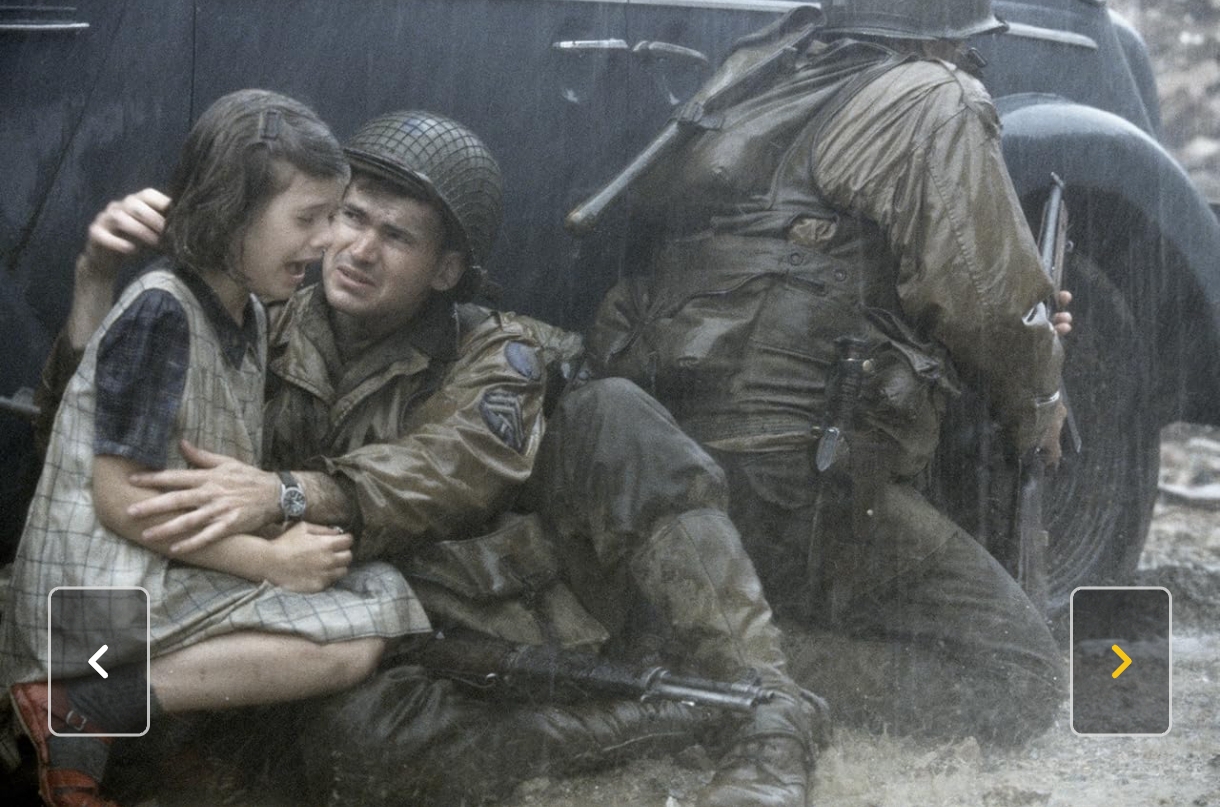
The opening D-Day sequence roughly 25 to 27 minutes long is the most unflinching depiction of combat I have ever encountered in mainstream cinema. Limbs are severed. Soldiers drown under the weight of their equipment. Men die screaming, or silently, or while trying to hold themselves together in ways that are genuinely disturbing to witness.
Put plainly: this is not action-movie violence. It is designed to be horrifying. Spielberg made it that way on purpose, and the Saving Private Ryan age rating of R reflects it though honestly, the rating still undersells the intensity of those early scenes.
The gore continues throughout the film, though at a lower register than the opening sequence. A key character death in the third act is prolonged and deeply upsetting. I have watched this film three times for professional reasons. It has not gotten easier.
Language
Strong language runs throughout the film, consistent with military settings in this era of cinema. The f-word is used repeatedly. There is no point pretending otherwise for parents checking Saving Private Ryan trigger warnings around language.
Grief, Moral Weight, and Survivor Guilt
This is where I think the film’s real challenge lies for younger viewers not the violence, but what it asks of you emotionally.
The film builds a genuine attachment to these characters and then takes them from you, one by one, with very little warning and zero sentimentality. My 16-year-old handled the combat sequences more steadily than I expected. What shook her was a quieter scene: a soldier waiting, knowing what is coming, and choosing to stay anyway.
The film does not resolve its central moral question. It presents it, and leaves you with it. That is the right artistic choice. It is also genuinely hard for younger viewers who are still building the frameworks to process moral ambiguity at that scale.
The Framing Narrative and PTSD
The film opens and closes with an elderly veteran at a military cemetery. This framing device is emotionally devastating in context not graphic, but heavy with accumulated meaning. It depicts, implicitly, what decades of carrying this experience looks like.
For children or teenagers with family members who have served in combat or are living with PTSD, this is worth knowing about in advance.
Age Guide
Under 13 Not appropriate. The graphic combat violence alone places this well outside what I would consider for this age group. The emotional themes are also several years beyond where most children in this range are developmentally. This is not a close call.
13 to 15 Proceed with real caution.There is a version of this viewing that is genuinely valuable for a mature 14 or 15-year-old who has already engaged with serious historical content. But the opening sequence is intense enough that I would want to preview it myself first, sit with them for the whole film, and be ready to stop and talk.
This is absolutely a parental judgment call, and I respect parents who decide to wait another year or two.
16 and 17 Yes, with a conversation.This is the age where the film genuinely starts to land the way it is meant to. My 16-year-old and I talked for forty minutes after watching it about the war, about the men in our own family history, about what it means to send young people into situations like that.
That conversation was worth more than most formal history lessons she has had. The Saving Private Ryan parental guidance for this group is not “should they watch it” it is “watch it with them.”
18 and over Unreservedly yes. One of the most important war films ever made.
Discussion Questions for Families
1. At the end of the film, the older Ryan asks his wife if he has been a “good man.” Why does he need that reassurance after all these years? What does that tell you about the weight that survivors of war carry for the rest of their lives?
2. There is a moment when Corporal Upham the translator does not act when he could have. Without spoiling it for anyone who hasn’t watched yet: why do you think Spielberg included that character, and what do you think he wanted us to feel about him?
3. Captain Miller’s squad openly debates whether the mission is worth the cost risking eight lives to save one. Do you think there is a right answer to that question? Does the film think there is?
4. How did the opening sequence make you feel? Do you think films about war *should* show combat that graphically or does showing it that way serve an important purpose?
FAQ
Is Saving Private Ryan safe for kids?
No, not for younger children. The film contains some of the most graphic war combat ever committed to mainstream cinema. The Saving Private Ryan age rating is R in the United States and 15 in the UK, and both of those reflect real content that parents should take seriously.
What age is Saving Private Ryan appropriate for?
I would say 16 as a general guide, with mature 15-year-olds considered on a case-by-case basis by parents who know their child. Younger than that, I would wait.
Does Saving Private Ryan have sexual content?
No. There is no sexual content in the film.
How violent is Saving Private Ryan?
Extremely. The D-Day opening sequence is sustained, graphic, and deliberately designed to convey the reality of combat including dismemberment, drowning, and soldiers dying in distressing detail. This is not background violence. It is central to what the film is trying to do.
Is Saving Private Ryan on streaming, and does the platform have an age limit?
Availability varies by region and changes over time check your current streaming platforms for the Saving Private Ryan streaming age limit in your country. The film is widely available on major platforms.
Does Saving Private Ryan have any trigger warnings beyond violence?
Yes. Grief, survivor guilt, PTSD (depicted in the framing narrative), moral questions with no clean resolution, and the prolonged death of sympathetic characters. Parents of children who have lost family members or who have family members with PTSD may want to consider timing and context carefully.

Henry Pham is a local movie critic with huge passion of films, mainly animation, who loves to share my passion on motion pictures. I’m also a member of North Texas Film Critics Association and Hollywood Creative Alliance (HCA). Bachelor of Arts and Humanities with a main focus on Film and Animation Studies from The University of Texas at Dallas.